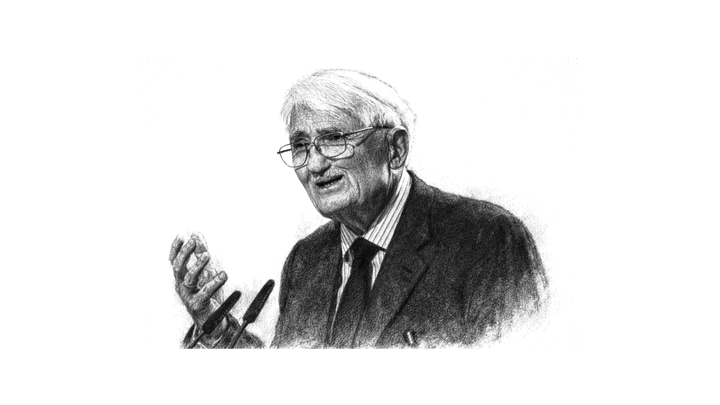
Public relations and lessons from Habermas
In today’s complex communication environment, public relations professionals must go beyond messaging to engage in meaningful dialogue. The work of Jürgen Habermas offers powerful insights into corporate communication, stakeholder engagement, and legitimacy.
The death of Jürgen Habermas invites a renewed look at the practical relevance of his ideas. Known primarily as one of the most influential social philosophers of the 20th and 21st centuries, Habermas wrote about democracy, discourse, and the role of public debate in modern societies.
Surprisingly, many of his core concepts are directly relevant to the work of PR professionals today. Corporate communication operates precisely in the space Habermas analysed: the intersection between organisations, media, and the public sphere. His theories about public discourse, macymacy, and communication offer a deeper perspective on what public relations actually does in society.
The public sphere as a space of negotiation
In his seminal work “The Structural Transformation of the Public Sphere”, Habermas described the public sphere as the arena where societal issues are debated, criticised, and ultimately legitimised. The public sphere is not just a media environment. It is a dynamic space where governments, companies, civil society, and citizens negotiate meaning and legitimacy through discussion. For companies, this insight has an important implication: they are not external observers of public debate. They are participants in it.
Public relations therefore play a structural role. PR does not simply distribute messages or generate media coverage. At its best, it helps organisations engage with the broader conversations taking place in society. In practical terms, this means good PR ensures that corporate positions are connectable to societal debates. Companies need to explain not only what they do, but also why their actions matter in a broader social context.
In that sense, PR contributes to the formation of public opinion.
Strategic communication vs. communicative action
Another cornerstone of Habermas’s thinking appears in “The Theory of Communicative Action“. In this work, he distinguishes between two types of communication. Strategic communication treats communication as a tool to influence behavior. It is goal-oriented and instrumental.
Communicative action, by contrast, aims at mutual understanding. Participants exchange arguments and seek agreement through rational dialogue. Critics often view public relations purely as strategic communication. In this view, PR exists mainly to shape perceptions or control narratives. But modern communication practice increasingly moves toward something closer to Habermas’s concept of communicative action. Today’s organisations must engage stakeholders, respond to criticism, and participate in ongoing public conversations. Dialogue has become a strategic necessity.
This is reflected in contemporary practices such as:
- stakeholder engagement
- corporate listening
- open dialogue formats
- purpose-driven communication
From a Habermasian perspective, legitimacy does not arise from persuasive messaging alone. It emerges when organisations participate credibly in public discourse.
Why legitimacy matters for companies
Habermas devoted much of his work to the question of how modern institutions maintain legitimacy. For companies, economic success is no longer sufficient.
In today’s public environment, organisations must also achieve:
- social acceptance
- moral justification
- narrative alignment with societal expectations
Public relations operate exactly at this intersection. Consider debates around sustainability, artificial intelligence, energy policy, or labor conditions. These discussions are not only technical or economic. They are deeply normative.
Organisations must explain not only what they do, but why their actions are legitimate in a broader social context. PR therefore functions as a translation layer between the economic system and society.
The role of public relations in public debate
Seen through Habermas’s lens, PR agencies perform a role that goes far beyond media relations.
They help organisations become communicatively capable within the public sphere. That includes tasks such as:
- structuring complex issues
- explaining corporate positions
- connecting business decisions to societal debates
- moderating conflicts and controversies
In that sense, PR agencies are part of the infrastructure of public discourse.
Habermas would likely phrase the role of communication differently than the industry usually does. Good corporate communication does not merely create attention. It helps create understanding and legitimacy in the public sphere.
For PR professionals, integrating Habermas’s thinking means moving beyond influence toward dialogue, legitimacy, and long-term trust.